

Adhesives and sealants
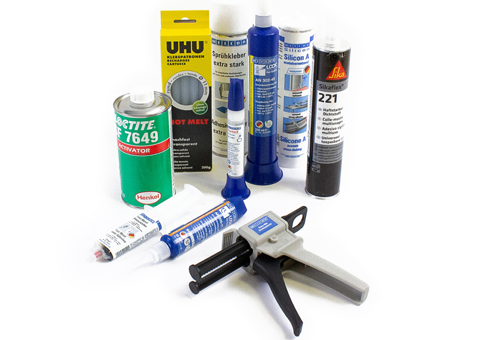
Tradition should be valued - but that doesn't mean you need to stick to it rigidly! Our certified in-house adhesive specialists are the perfect example. Adhesives are a great and often innovative way of joining components. In fact, there are enough different adhesives out there to cater to the needs of any industry, from Swiss watchmakers to automotive and rail vehicle manufacturers, production facilities and development teams. No wonder our adhesive specialists are in such high demand!
Adhesive tapes
Adhesive tapes are a collective term for strip-shaped carrier materials coated on one or both sides with pressure-sensitive adhesives, e.g. made of plastic films or foams, paper, metal foils or textile fabrics. In industrial manufacturing, so-called transfer adhesive tapes are also used: carrier-free, thin films of pressure-sensitive adhesive that are covered on both sides with waxed or siliconized protective paper before processing. Adhesive tapes can also be processed into self-adhesive labels in tape form by printing and die-cutting.
Applications: Automotive and electronics industry, construction, art and design, model making, marine industry, medical technology, mechanical engineering
Application: Automotive and electronics industry, construction, art and design, model making, marine industry, medical technology, mechanical engineering


Casting resins
Polyurethane- and epoxy-based casting resins have found ever wider applications in recent decades, as they are extremely diverse in their property profile. A wide range of properties can be achieved by modifying the chemical composition accordingly. This makes it possible to produce very hardness and impact resistant as well as also soft and elastic materials. As a rule, polyurethanes are light to process and they prove their reliability and precision in a wide range of manufacturing processes.
Applications: Automotive and electronics industry, construction, art and design, model making, marine industry, medical technology, mechanical engineering
Application: Casting resins are used in the automotive and electronics industry, construction, art and design, model making, marine industry, medical technology, mechanical engineering


Contact adhesives
The classic contact adhesives stand for powerful connections - whether at small repairs or big bonding areas. With the contact adhesives, combination bonding of wood-based materials with HPL plates such as Resopal, Formica and others, rubber, leather, cork, felt, hard PVC, flexible foams, metal and many more is possible. It is suitable for laying sound-absorbing, insulating and acoustic plates, suitable plastic tiles and wall coverings of various styles on load-bearing, dry substrates.
Applications: Furniture, automotive, shoe, textile and construction industries, craftsmen, electronics, packaging industry, aviation and in retail.
Application: Furniture, automotive, footwear, textile, construction, craftsmen, electronics, packaging, aviation and retail industries


Dosing technology: to the point.
Increasing automation of processes is also synonymous with non-manual adhesive handling, which makes use of modern dosing systems in a wide variety of dimensions. The dispensing technology used depends on properties like viscosity or the quantity to be applied. Bonding the smallest chips to circuit boards only works with systems that can dose liquid adhesives in the microliter range, while other applications provide large quantities of pasty adhesives from barrels, e.g. for bonding discs in trains. Good dispensing systems apply 2-component adhesives in the same high quality as 1-component adhesives. This also makes it possible to integrate dosing systems as a fully-fledged application in complex and fully automated production lines
Applications: Construction, trades, maintenance, electronic, automotive and packaging industries, manufacturing companies, furniture industry
Application: Construction, skilled trades, maintenance, electronic, automotive and packaging industries, manufacturing companies
Epoxy resins adhesives
Epoxy resin adhesives are mainly used for high force transmission, where they replace conventional mechanical joining techniques. Parts that are connected with such an adhesive form a tight connection. Mechanical properties such as high strength, high shear modulus and high adhesion have proven themselves in practice many times over for applications at the customer. This is especially true for demanding applications in the air, aerospace and automotive industries.
Applications: Automotive, electronic, construction, air and aerospace, shipbuilding, wood and metal processing, art and design
Application: Automotive, electronics, construction, air and aerospace, shipbuilding, wood and metal processing, art and design
Instant adhesives (cyanoacrylates)
Instant adhesives are also designated as one-component adhesives. They harden very quickly between closely fitting and cleaned surfaces by air humidity. For this reason, they should always be bedded dry and cool. They are extremely suitable for especially small surfaces.
Applications: Construction, electronics, automotive industry, medical technology, model making, jewelry manufacturing, dental industry, wood processing
Application: Construction, electronics, automotive industry, medical technology, model making, jewelry manufacturing, dental industry, wood processing

Polyurethanes
Polyurethanes are sealants with high tear resistance and high elongation at break for structural and civil engineering applications. PU sealants have a wide adhesion spectrum. Polyurethanes are used in outdoor areas because they are resistant to early rain, i.e. the new sealant introduced does not wash out.
Applications: Automotive and electronics industry, construction industry, mining and construction machinery, wood processing, aviation, sanitary and installation companies, packaging industry
Application: Automotive and electronics industry, construction industry, mining and construction machinery, wood processing, aviation, sanitary and installation companies, packaging industry
Protective coatings
Industrial plants are constantly exposed to external attacks. Tanks, pipes and floor coatings made of concrete are affected, as are engines, compressors, heat exchangers or fans made of metal. Only a high quality filling and surface coating will reliably protect your systems against wear, abrasion, erosion, corrosion and chemicals. Probate materials like epoxy adhesives (especially for concrete and aluminum repair), metal coating made of epoxy as well as ceramic particles used in places form the basic of our high-performance surface coating. These are available in trowelable, brushable and sprayable forms.
Applications: Construction industry, oil and gas industry, energy sector, automotive and marine industry, air and aerospace industry, chemistry and process industry, food and beverage industry
Application: Construction industry, oil and gas industry, energy sector, automotive and marine industry, air and aerospace industry, chemistry and process industry, food and beverage industry
Repair with liquid metal
Metal-filled epoxy adhesives are used to permanently repair, rebuild and restore damaged machines and systems - without heat and without welding.
Applications: Automotive and construction industry, aerospace, electronics, metalworking, mechanical engineering, energy sector, shipbuilding, medical technology, maintenance
Application: Automotive and construction industry, aerospace, electronics, metal processing, mechanical engineering, energy sector, shipbuilding, medical technology, maintenance
Retainers
Retainers mount bearings, bushings and other cylindrical parts in housings and on shafts. They can be used for aesthetic reasons in order to dispense with mechanical fasteners.
Application: Automotive and packaging industry, electronics, construction, air and aerospace, mechanical engineering, chemistry and process industry, medical technology, food and energy industry

Screw lock
Threadlockers offer protection against loosening by vibration, improve the strength and corrosion resistance of connections of screws and threads. They are temperature and vibration resistant, withstand certain chemicals and can also be used as sealants.
Applications: Automotive, construction and electronics industry, energy industry, air and aerospace, marine industry, medical technology, mechanical engineering
Application: Applications in many industries: Automotive, construction and electronics industry, energy industry, air and aerospace, marine industry, medical technology, mechanical engineering
Silicones Silicone adhesives
Silicone adhesives are mainly used to absorb or compensate for dynamically occurring high loads by their elasticity; the transmission of forces inbetween the joining partners is less in the foreground. In addition to their elasticity, many elastic sealings also have a high inner strength (cohesion) and a comparatively high modulus of elasticity. As a result, they allow for material-locking connections that also have elastic properties.
Applications: Automotive and electronics industry, construction industry, mining and construction machinery, wood processing, aviation, sanitary and installation companies, textile and packaging industry
Application: Automotive and electronics industry, construction industry, mining and construction machinery, wood processing, aviation, sanitary and installation companies, textile and packaging industry
Spray adhesives
Spray adhesives are contact adhesives in spray form for small and big surfaces. It bonds quick, strong and clean with itself and with many other materials. Uniform, extra fine spray pattern - adhesive nozzle does not stick together. Does not punch through, therefore ideal for thin materials such as paper, box, textiles, leather, felt, foams, many plastics, Styrofoam®, with itself and with many other materials, e.g. with wood, glass, metal, ceramic
Application: Furniture and wood processing industry, automotive, shoe, textile and construction industry, craftsmen, electronics, packaging industry, advertising and graphics industry, art and decoration companies
Thread seals: ready to flow.
Nothing out and nothing pure - that describes liquid thread seals to the point. Used to make small and big threads safer, thread seals can be used to seal the spaces between threads permanently and over the long term. Provided the application requires it. Best of all, they not only prevent liquid or gaseous substances from leaking or escaping from the thread, but also buffer vibrations, temperature fluctuations and even chemical influences.
Applications: pipeline construction, energy sector, automotive and packaging industry, construction industry, air and aerospace, mechanical engineering, chemistry and process industry
Application: Thread seals are used in applications in pipeline construction, the energy sector, the automotive and packaging industry, construction, air and aerospace, mechanical engineering, and the chemistry and process industries
UV adhesives: the addicts.
There are single-component adhesives that cure within seconds at room temperature according to UV irradiation; these are known as UV adhesives. The industry is delighted because production can then really step on the gas. However, at all the anticipation of more performance, one thing must not be forgotten: UV adhesives only work if at least one of the components to be joined is permeable to UV light.
Applications: electronics, medical technology, optics and glass industry, furniture and decoration industry, printing industry, plastics processing, watch industry, research and development
Application: Electronics, medical technology, optics and glass industry, furniture and decoration industry, printing industry, plastics processing, watch industry, research and development