


Pneumatic -Compressed air, without compromise.
From pneumatic fittings, couplings and cylinders to pipelines, screw connections, valves and even maintenance units, our range of pneumatic products is huge – and every item complies with our exacting in-house standards.
Pneumatic: Is clean. And sometimes also lubricated.
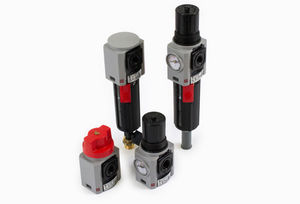
Where pressure is created by compressing single air, a large number of components and parts are required to protect the compressed air system and safeguard the process. Because on the one hand there are stop valves, which are needed to make downstream components pressureless, e.g. in the event of maintenance. Ambient air is by no means as pure as is often believed; it also contains particles. Compressed air contains many times more particles on a small surface area. Compressed air filters remove these particles and also the additional condensate. The design of such a compressed air filter depends on the application and the compressed air quality class required there. Pressure reducers are inserted in compressed air treatment systems to reduce the compressed air inserts to the required working pressure.
Pressure limit valves are indispensable in systems for compressed air control. The names pressure relief valve or safety valve are also commonly used in everyday life. As the name suggests, pressure limit valves limit the approval or maximum pressure in the system. If the pressure exceeds the permissible value, the valve opens and vents. It's hard to believe, but despite air cleaners and oil separators, compressed air lubricators are still needed elsewhere in the industrial environment: They are inserted after filters or controllers and ensure a long service life for components by lubricating them. In compressed air systems, maintenance units deliver what their name promises: as an assembly, they ensure the preparation of compressed air. If they do their job properly, the other components of the compressed air treatment system pay off with a longer service life.
Compressed air lubricators


Gauges (pneumatic)
Maintenance units / Filter regulators
Pneumatic filter
Pressure regulators
Pressure relief valves
Shut-off valves (pneumatic)
Soft start dump valves
Fittings/ball valves (pneumatic)
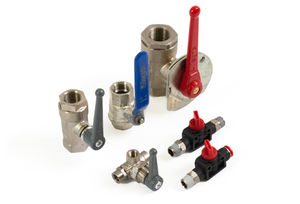
Ball valves are fittings for shutting off pipelines and containers or also for diverting or splitting a media flow (2-way or reusable ball valves). They can be actuated manually by a hand lever or pneumatically (single-acting, spring reset, double-acting) or electrically by a swivel drive.
Ball valves (pneumatic)
Electric actuation drives
NAMUR control valves
Pneumatic swivel drives
Position feedback boxes
Shut off valves
Pneumatic cylinders
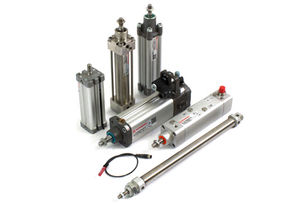
Standardized or not standardized - that is the question here, although not the most important one. With pneumatic cylinders, a distinction is made between standardized and not standardized cylinders. It becomes interesting when it comes to spare parts procurement and repair tasks: standardized cylinders can be replaced by components with the same norm from other manufacturers. Incidentally, pneumatic drives are divided into short-stroke and compact cylinders, linear cylinders (rodless cylinders), bellows cylinders, impact cylinders and also rotary cylinders.
Bellows cylinder

Compact cylinder
ISO cylinder
Impact cylinder
Linear cylinder
Rotary cylinder
Pneumatic screw connections
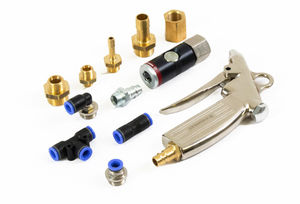
Fittings are often called compressed air connectors or fittings in pneumatics and are important components. In every pneumatic application, hoses or pipes are used that need to be connected to a valve or another component of the pneumatic system. The screw connections can be made of plastic as well as stainless steel or brass and may need to have application-specific media resistance.
Compression fittings
Fittings (pneumatic)
Functional fittings
Push-in fittings
Push-on fittings
Quick release couplings
Silencer
Pneumatic hoses
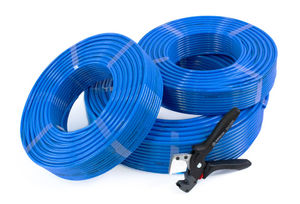
Hoses are flexible pipelines for conveying fixed, liquid and gaseous substances.
Absaugschläuche
Armorvin Schläuche
Decabon-Rohr
Druckluftschläuche
Industrial hoses
PA hoses
PE hoses
PTFE-Schläuche / Teflon Schläuche
PU hoses
PVC hoses
PVC-Gewebeschläuche
PVC-Spezialschläuche
Saug- und Druckschläuche
Schlauchaufroller
Silikonschläuche
Spiral hoses
Wasserschläuche
Werkstattschläuche
Pneumatic valves: They regulate that.
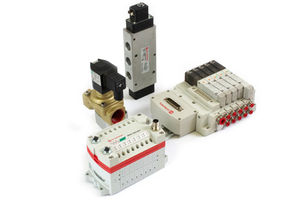
There is much more than just discharging air: valves are just as versatile as cylinders: magnetic valves are actuated electrically and take on the functional role of a control device. Valve islands combine several valves on one plate, for example, whereby the electrical supply is also implemented centrally here.
As the name suggests, proportional or pressure regulating valves work proportionally and have a closed control loop. This means that the value at the input is continuously compared with the value at the outputs. If there is a difference, the proportional pressure regulating valve adjusts according to it.
If cylinder speeds need to be adjusted, for example, check/power valves or throttle and throttle check valves are integrated in many controls. Also very interesting: so-called logic valves. As shuttle valves, also known as OR links, and the two-pressure valves or AND links, they are inserted to process pneumatic signals.
Directional control valves
ISO valves
Medienventile
Prozessventile
Schrägsitzventile
Shut-off/flow valves
Solenoid valves
Valve islands
Pressure switches: strong pulse generators.
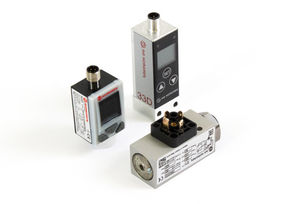
If you want something solid and the measuring accuracy rolls a rather subordinate role, the less cost-intensive electro-mechanical pressure switches are the means of choice. They convert the fluid pressure into a mechanical movement - either via a membrane or with a piston, depending on the design. Electronic pressure switches are different: they use electronic pressure sensors to measure the pressure and activate the switch output. They are much more precise when measuring and therefore much more reliable than electro-mechanical ones, but also cost several times more.
Electro-mechanical pressure switches
Electronic pressure switches
Vacuum technology
The terms "overpressure" and "vacuum" refer to whether the pressure is larger or smaller than the normal athmospheric pressure. In pneumatics, the unit of measurement bar is used for both overpressure and vacuum. At absolute vacuum, the absolute pressure is 0 bar, the gauge pressure is then -1 bar.
Ejectors/vacuum pumps
Suction cups/vaccum cups
Vacuum switch


Contact