
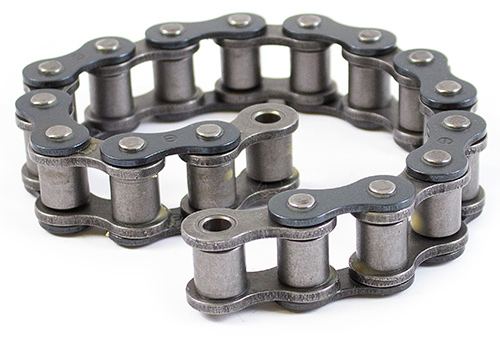
The best connections imaginable: Chains
As a machine and plant manufacturer, you know just how much of the burden chains have to carry in industrial environments. The preferred option for drives, industrial manufacturing, the pharmaceutical industry, food production and many other sectors, they are expected to do the same thing day in, day out: turn and transmit forces. Some are subjected to even more demanding tasks, but on a fundamental level, we want one thing from our chains: for them to do every job reliably. Chains and their links come in a wide variety of forms and can be moved in different ways.
Of course, what chain you need depends on the prevailing forces in your transport system, agricultural machine, conveyor belt or filling line, or any number of other chain applications. We have the right chain for every application and requirement. And if you want information on the power of one of our chains, we can calculate that for you ourselves. Let us find the perfect chain for your application and help your designers make the right choice. With us, the sky's the limit!
Agricultural chains
Agricultural chains are not infrequently a small rolling factory and - depending on the task - operates either above or below. The agricultural machine sectors designed for this purpose ensure, for example, that combine harvesters with their entry or elevator chains do an efficient job in the grain field or that potato and beet harvesting is quick. Not forgetting chains that are in a position to pick maize, sunflowers or special crops.
Applications: Agricultural machinery, maize harvesters, balers
Chain tensioners
Smooth rotors during a long period of operation and the absorption of vibrations and joints - two things that are always relevant when operating a chain. A chain tensioner does exactly that and is therefore the preferred device for tensioning a chain at systems and machines of any style.
Applications: conveyor systems, industrial machinery, mechanical engineering
Chain tensioning wheels
Chain adjusting wheels can be fixed or flexibly integrated into a design - they can be used for single deflection of the chain or also for additional tensioning. Chain adjusting wheels are particularly indispensable where wear-related elongation of the chain needs to be compensated for. In combination with a flexible tensioning system, it automatically improves running smoothness. This ensures smooth running in the system even at high loads and speeds.
Applications: conveyor systems, industrial machinery, mechanical engineering
Conveyor chains (bush conveyor chains)
Conveyor chains are used for the transport of goods and qualities, often with carriers or hinged fittings. Bush conveyor chains usually have metric seperations. These chains are used in many different applications and are especially suitable for long conveyor lengths with relatively low speeds. The range of variants is enormous: a rotary chain, for example, which is intended for heavy inserts, consists only of cranked links, which gives it increased elasticity and can absorb load shocks well. In industry, conveyor chains are rarely used as pure standard chains; instead, they are often customized according to specific customer requirements.
Applications: The sum of these properties and the wide range of variants in terms of properties and choice of materials make conveyor chains a cross-sector lotion from industrial environments right up to the very clean and highly regulated food or pharmaceutical industries.
Flat top chains
Flat top chains are conveyor chains consisting of plates that are connected to each other by hinges. They are often used in conveyor and transport applications to enable linear and curved movement of materials. Slatband chains are preferred for conveying unit loads with a low weight. The choice of material for the chains must be adapted to the ambient conditions. They can be made of steel, plastics or stainless steel.
Applications: Wet and dry areas, like for example in the food industry at filling plants, transport and logistics, automotive industry
Guides for roller chains
To ensure that chains run in a predetermined track and transport processes run in an orderly fashion over long lengths and/or periods of time, they are guided by chain guides. Manufactured from polymers or steel, these accessories have to withstand a lot. Good chain guides impress with their high wear resistance. High quality chain guides are also impact resistant and, for inserts in the chemical industry, resistant against chemicals. Suitable for acids, alkalis, dust, lubricating- or coarse chemicals.
Applications: Conveyor systems, industrial machinery, mechanical engineering
Leaf chains (lifting chains)
In contrast to roller chains, flyer chains are made exclusively of bolts and flaps, which gives them an especially high breaking strength. These chains are used wherever heavy loads need to be raised or drawn. They are often found in the lifting masts of forklift trucks, but they are also inserted as counterweight chains in machine tools, as draw bench chains or in container lift trucks. Flyer chains are reliable load carriers that can be adjusted according to customer specifications and comply with the requirements of the EC Machinery Directive 2006/42/EC. The link plates are precisely shaped, heat-treated, tapered and shot-blasted, giving them an especially high load-bearing capacity. The plain, high-strength surfaces of the bolts significantly increase wear resistance. An improved press fit between the bolt and outer flaps also ensures increased fatigue strength of the chains.
Applications: Forklift trucks and stacker cranes in logistics
Plastic modular belts
Mat chains or mat conveyors are highly resilient and versatile in their applicability. Their robust design makes them especially suitable for conveying big loads and heavy materials. They are especially low-maintenance and also cost-effectively applicable for larger conveyor systems. Mat chains can take on different forms and transport goods in curves, straight lines or even inclinations. This optimizes the use of space. They are also low-noise as other conveyor systems, which reduces noise pollution for employees.
Applications: Automotive industry, food industry, logistics and storage, packaging industry, bottle and can transport and many more.
Roller chains
Roller chains are widely used in machine and plant construction. They are used not only as drive and transmission chains, but also as hub, pinion and conveyor chains. There are additional special designs with various carriers that are used for transport and conveying purposes. With the suitable attachments, roller chains offer special functionalities and are therefore applicable in a wide range of applications.
Applications: Mechanical engineering, food industry, packaging industry, agricultural machinery
Tools for chains
Some tools are required to assemble chains according to their operating conditions. These can be chain cutters, mounting tensioners or replacement parts like bolts, links, flaps and brackets for chains.
Applications: Mounting and dismounting of chains in maintenance work
Contact